
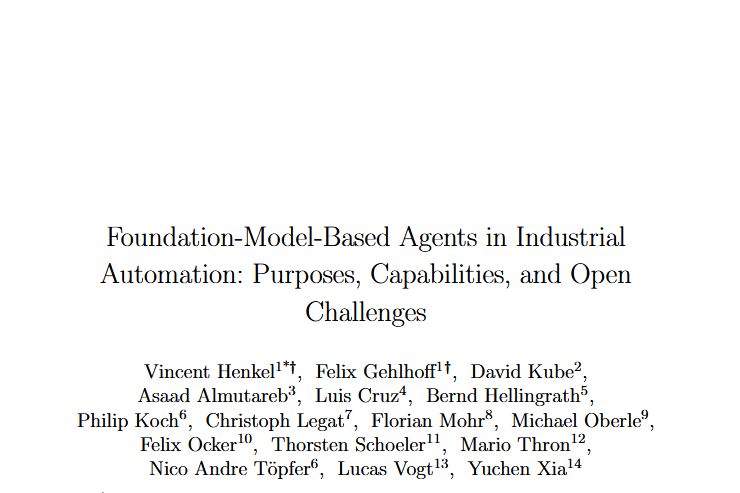
We are pleased to announce the publication of a new research paper, “Foundation-Model-Based Agents in Industrial Automation: Purposes, Capabilities, and Open Challenges,” co-authored by contributors from academia, research institutes, and industry, including Artiquare GmbH.
The paper examines how foundation-model-based agents, particularly systems built around large language models and multimodal foundation models, are emerging in industrial automation. These systems are increasingly being explored for tasks such as decision support, process monitoring, engineering automation, maintenance support, and tool orchestration.
As one of the contributing organizations, Artiquare is proud to have supported this work and to be part of the broader discussion on how agentic AI can be responsibly and effectively applied in industrial settings.
Why this work matters
Industrial automation has a long history of using software agents and multi-agent systems for distributed decision-making, planning, scheduling, control, and coordination. However, the rise of foundation models introduces a new class of industrial agents: systems that can interpret unstructured information, interact with humans through natural language, reason over complex context, and invoke external tools or services.
This shift creates exciting opportunities, but it also raises important questions:
How mature are these systems today?
Which industrial use cases are they best suited for?
How do they compare with conventional industrial agent systems?
What limitations still prevent reliable deployment?
The paper addresses these questions through a systematic literature review of 88 publications, selected from 2,341 unique records, following a PRISMA-style review process.
Key findings from the paper
One of the main findings is that foundation-model-based industrial agents are promising, but still largely at the prototype and early validation stage. The review found that 75.0% of reported systems are at TRL 4–6, while only 9.1% provide deployment-oriented evidence.
The paper also shows a shift in the role of industrial agents. Conventional agent systems have often focused on production-control tasks such as planning, scheduling, dispatching, and negotiation. In contrast, foundation-model-based agents are currently used more often for user assistance, monitoring, process optimisation, engineering support, and decision support.
Compared with conventional industrial agent systems, the reviewed foundation-model-based agents show notable gains in human interaction and dealing with uncertainty, but they show a significant deficit in negotiation, a classical capability of multi-agent systems.
The paper also identifies several recurring barriers to deployment, including limited generalization, hallucination and output instability, data scarcity, inference latency, prompt sensitivity, integration complexity, tool-use failures, and privacy or security risks.
A contribution toward clearer terminology
A central contribution of the paper is a working definition of a foundation-model-based industrial agent. The proposed definition bridges conventional agent theory, automation-engineering standards, and the foundation-model paradigm.
This is important because the term “agent” is often used inconsistently across current AI literature. By proposing a more precise definition, the paper helps distinguish true foundation-model-based industrial agents from systems that merely use LLMs for text generation or conversational interfaces.
What this means for industrial AI
The findings suggest that foundation-model-based agents are not simply a replacement for classical industrial agents. Instead, they represent a complementary paradigm.
Their strengths are especially visible in tasks that involve natural-language interaction, heterogeneous information sources, ambiguous context, engineering knowledge, and tool orchestration. At the same time, classical algorithms and conventional agent mechanisms remain highly relevant for well-defined computational tasks such as scheduling, optimization, control, and negotiation.
For practical industrial deployments, this points toward hybrid architectures: foundation models can support interpretation, reasoning, interaction, and orchestration, while established automation and optimization methods continue to provide reliability, determinism, and domain-specific execution.
Looking ahead
At Artiquare, we see this work as part of a broader effort to make industrial AI systems more useful, reliable, and aligned with real-world engineering requirements.
Foundation-model-based agents have the potential to improve engineering productivity, support operators and domain experts, simplify access to industrial knowledge, and enable more adaptive automation workflows. However, the path to deployment requires rigorous validation, robust system integration, safety mechanisms, and clear evaluation standards.
We are proud to have contributed to this paper and look forward to continuing the conversation on how agentic AI can be responsibly applied in industrial automation.
Paper: Foundation-Model-Based Agents in Industrial Automation: Purposes, Capabilities, and Open Challenges [abstract]
Contributing organizations: Institute of Automation Technology, Helmut Schmidt University / University of the Federal Armed Forces Hamburg, Hamburg, Germany.Siemens AG, Nuremberg, Germany; Institute for Technologies and Management of Digital Transformation, Bergische Universit¨at Wuppertal, Germany. Artiquare GmbH, Ingolstadt, Germany. Facultad de Ingenier´ıa Mec´anica, Electr´onica y Biom´edica (FIMEB), Universidad Antonio Nari˜no, Bogot´a, Colombia. Chair of Information Systems and Supply Chain Management, University of M¨unster, M¨unster, Germany. Fraunhofer Institute for Manufacturing Technology and Advanced Materials IFAM, Stade, Germany. Research Group on Cognitive Autonomy & Predictive Intelligence, Faculty of Electrical Engineering, Technical University of Applied Sciences Augsburg, Augsburg, Germany. Birkenfeld Institutes of Technology, Trier University of Applied
Sciences, Birkenfeld, Germany. Fraunhofer Institute for Manufacturing Engineering and Automation IPA, Stuttgart, Germany. Honda Research Institute Europe, Offenbach am Main, Germany. Faculty of Computer Science, Augsburg Technical University of Applied Sciences, Augsburg, Germany.
Topic: Foundation models, large language models, multi-agent systems, industrial automation, systematic literature review.
We’re artiquare. We build reliable multi-agent AI for German industry.
Open source: github.com/artiquare/caa